Insomnia and Early Morning Awakenings | 失眠和早醒
What large-scale studies say? Strategies to try out tonight!
HEALTH
2/25/20264 min read
Insomnia and Early Wakening | 半夜睡不着和早醒的对策
Disclosure: As an Amazon Associate I earn from qualifying purchases – at no cost to you. 作为亚马逊联盟会员,我从符合条件的购买中获得收益-对你没有任何额外费用。
-------------------------------------------------------------------------
中文版 (English Version Follows Below.)
权威《睡眠》杂志2022年有一项大型的关于失眠和哪些应对策略有效的研究,该研究对 1,358 名日本员工进行了为期两年的跟踪调查,摘要如下:
“失眠者的应对模式(coping strategies)更倾向于用错误的应对方式来应对他们的失眠症买。失眠的严重程度和应对模式成正比。如果选择了错误的应对方式,会进一步加剧他们的失眠,从而形成一种“压力 - 不良应对 - 失眠加重”的循环。”
实操建议
下面这里是其他科研和我自己的经验总结, 有几条非常具体,今晚就能用的实操建议:
1. 中西医疗法 (Chinese Medicine)
中医说如果睡不着或者早醒,那是因为肝脏和肺不舒服,有热气,所以让人心神不定,喝菊花胎能降火气安神。我要是睡眠不好的时候,白天就热水泡菊花胎喝,试了很多多年,一直都有效果。我一个朋友试了没有用,估计人和人不同。
西医的说法也说了肝脏如果不舒服“累了,有压力了”,晚上不能很好地分解糖元,让大脑不安分。可以吃镁片甘氨酸镁 (Magnesium Glycinate)对睡眠和肌肉放松的作业非常好。失眠的人要是不想吃安眠药的人,可以从镁片开始。
我两个都吃很多年了,特别是我是锻炼的,镁片甘氨酸镁能放松肌肉好睡觉呀啊。
2.建立“睡眠缓冲区” (The 15-Minute Rule)
如果你躺在床上超过 15-20 分钟还没睡着,或者感觉开始心烦意乱了,那就立即起床, 避免床和“清醒、挫败、焦虑”产生强关联。去另一个房间,只开一盏昏暗的小灯,坐一会儿。直到你感觉到眼皮沉重了, 有了真正的困意,再回卧室。
3. 准备一个“大脑垃圾桶” (Brain Dump)
针对研究中提到的“积极应对”,如果你是因为担心明天的事情而清醒,在床头放纸和笔。把脑子里担心的事、明天要做的清单全部写下来。这种 “工具性支持(Instrumental Support”, 告诉自己的大脑:“信息已储存,现在可以关闭运行了。”
3. 尝试“矛盾意向法” (Paradoxical Intention)
当你躺在床上时,不要想“我要睡着”,反而对自己说:“我要保持清醒,我倒要看看我能睁着眼多久。” 这属于积极重构(Positive Reframing)。失眠往往源于你的“必须睡着”的压力,当你主动要求“不睡”时,这种焦虑压力消失了,大脑反而会迅速进入睡眠状态。
4. 练习 4-7-8 呼吸法或生理性叹息
吸气 4 秒。 2. 憋气 7 秒。 3. 呼气(发出呜呜声)8 秒。这不是为了“变魔术”让你秒睡,而是通过延长呼气时间来激活副交感神经,强制让身体从“战斗模式”切换到“休息模式”。
5. 控制“光线与温度”
身体核心温度下降是入睡的信号。半夜醒来可以尝试换一个凉爽的枕头面,或者把脚伸出被子外。 即使是去洗手间,也不要开刺眼的头顶灯。使用声控或感应的微弱地灯。
6. 禁止“看钟” (No Clock Watching)
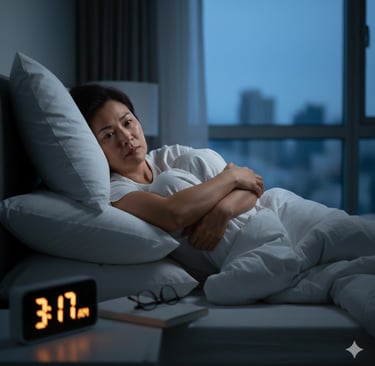
把闹钟转过去,或者把手机放远。看到“凌晨 3:15”会瞬间触发大脑的自我责备(Self-blame)和数学计算(“天哪,我只能睡 4 小时了”),这会分泌皮质醇,让你彻底清醒。
English Version
Countermeasures for Midnight Insomnia and Early Awakening
A 2022 large-scale study in the authoritative journal Sleep regarding insomnia and effective coping strategies conducted a two-year follow-up study of 1,358 Japanese workers.
The abstract is as follows: "The coping patterns (coping strategies) of individuals with insomnia tend toward using incorrect methods to deal with their insomnia. The severity of insomnia is directly proportional to the coping pattern. If incorrect coping methods are chosen, it will further exacerbate their insomnia, creating a cycle of 'stress - maladaptive coping - worsened insomnia.'"
Practical Suggestions from Tonight
Below are summaries from other scientific research and my own experience, including several very specific practical tips you can use tonight:
1.Chinese and Western Medicines: Chinese medicine says that if you can't sleep or wake up early, it's because the liver and lungs are uncomfortable and have "heat," making the mind restless. When my sleep is poor, I drink hot water steeped with fetal chrysanthemum (Ju Hua Tai) during the day.
I've tried this for many years, and it has always been effective. A friend of mine tried it and it didn't work, so I guess it varies from person to person.
Western medicine also suggests that if the liver is "tired" or under stress, it cannot efficiently break down glycogen at night, which keeps the brain restless. Taking Magnesium Glycinate can be very effective, as it significantly aids in sleep quality and muscle relaxation. For those suffering from insomnia who want to avoid sleeping pills, starting with magnesium supplements is a great option.
I have had both the fetal chrysanthemum and magnesium glycinate for many years.
2.Establish a "Sleep Buffer" (The 15-Minute Rule): If you have been lying in bed for more than 15-20 minutes and haven't fallen asleep, or feel yourself starting to get frustrated and anxious, get out of bed immediately. Avoid creating a strong association between the bed and "wakefulness, frustration, and anxiety."
Go to another room, turn on a single dim light, and sit for a while. Wait until you feel your eyelids getting heavy and you have genuine sleepiness before returning to the bedroom.
3.Prepare a "Brain Dump": In line with the "Active Coping" mentioned in the study, if you are awake because you are worried about tomorrow's affairs, keep paper and a pen by the bed. Write down everything you're worried about and your to-do list for tomorrow. This is "Instrumental Support," telling your brain: "Information has been stored, you can shut down now."
4.Try "Paradoxical Intention": When lying in bed, don't think "I must fall asleep"; instead, tell yourself: "I want to stay awake, I want to see how long I can keep my eyes open." This belongs to Positive Reframing. Insomnia often stems from the pressure of "having to fall asleep." When you actively request "not to sleep," this anxiety pressure disappears, and the brain often falls into a sleep state quickly.
5.Practice 4-7-8 Breathing or Physiological Sighing
Inhale for 4 seconds. 2. Hold your breath for 7 seconds. 3. Exhale (making a "whoosh" sound) for 8 seconds. This isn't a "magic trick" to make you fall asleep instantly, but rather uses prolonged exhalation to activate the parasympathetic nervous system, forcing the body to switch from "fight mode" to "rest mode."
6.Control "Light and Temperature": A drop in core body temperature is a signal for sleep. If you wake up in the middle of the night, try flipping to a cool pillow surface or sticking your feet out of the blanket. Even if you go to the bathroom, do not turn on harsh overhead lights. Use sound-activated or motion-sensing dim floor lights.
7.Prohibit "Clock Watching" (No Clock Watching) ": Turn the alarm clock around or put your phone far away. Seeing "3:15 AM" will instantly trigger the brain's Self-blame and mathematical calculations ("Oh my god, I can only sleep for 4 hours"), which secretes cortisol and makes you wide awake.
References
Otsuka Y, Itani O, Matsumoto Y, Kaneita Y. Associations between coping strategies and insomnia: a longitudinal study of Japanese workers. Sleep, 2022 Feb;45(2):zsab244. doi: 10.1093/sleep/zsab244. PMID: 34585730; PMCID: PMC8842145.
This study found that Japanese workers who used negative habits like blaming themselves, venting, or using alcohol to deal with stress actually made their insomnia much worse over time. The researchers recommend using positive strategies instead, such as focusing on solving the actual problem, using humor, and asking friends for support to help break the cycle of poor sleep.
Fiorentino L, Martin JL. Awake at 4 AM: treatment of insomnia with early morning awakenings among older adults. J Clin Psychol. 2010 Nov;66(11):1161-74. doi: 10.1002/jclp.20734. PMID: 20845423; PMCID: PMC3377480.
This article explains why many older adults struggle with waking up too early, often as early as 4 a.m., due to natural changes in their body's internal clock as they age. It suggests that the best way to fix this is not through medication, but by using "sleep therapy" to change daily habits and "light therapy" (like evening sun exposure) to help reset the brain's timing for a later wake-up call.
声明|Disclosure
As an Amazon Associate I earn from qualifying purchases – at no cost to you.
作为亚马逊联盟会员,我从符合条件的购买中获得收益
— 对你没有任何额外费用。
网站设计 |Website Design
喜欢我的网站设计吗? Hostinger 的AI模版帮了不少忙,不需要懂编程。用我的链接省20% 。
Like my website created with Hostinger? Its AI-assisted function can help a beginner develop a website with great vision and experience without knowing coding! Use my Hostinger referral link to save 20% off。喜欢我的网站设计吗? Hostinger 的AI模版帮了不少忙,不需要懂编程。用我的链接省20% 。
© 2026. All rights reserved.