Fitness and Diet Relationships | 饮食和健身的关系
Don't just lose weight. Build a body that's worth the weight.
FITNESS
2/8/20262 min read
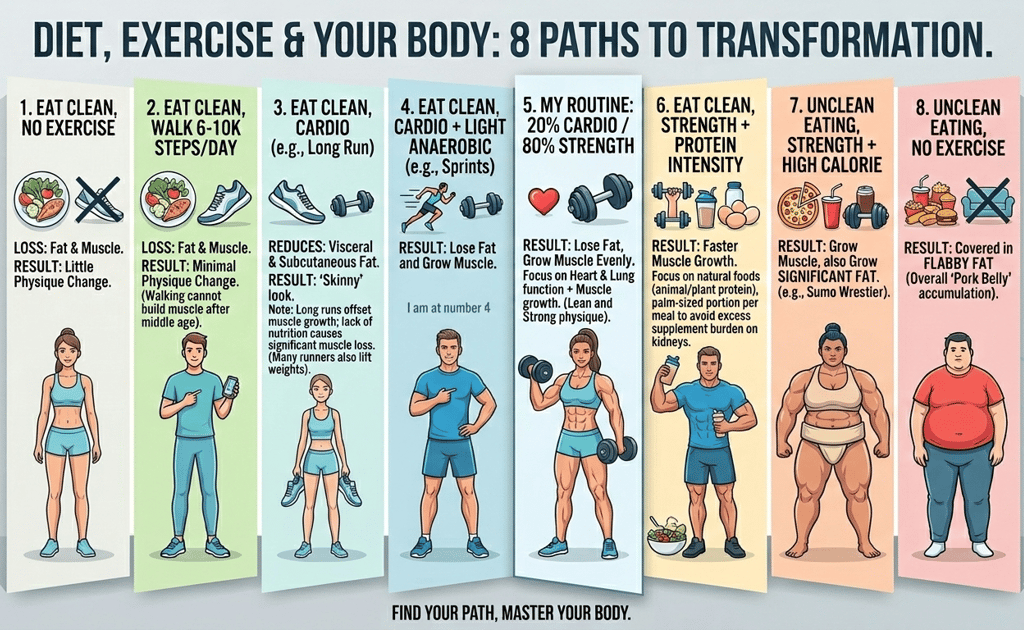
Fitness and Diet Relationships | 健身与饮食关系对照表
中文版 (English Version Follows Below.)
什么是有氧运动 (Aerobic Exercise)
有氧运动通过提高心率和呼吸,利用氧气为肌肉供能。它能显著增强心肺功能与耐力,并在运动时高效燃脂,是预防心脏病、提升体能的核心手段。此外,它能释放内啡肽,缓解压力并改善情绪。例子: 慢跑/长跑、游泳、骑行、快走、划船、跳绳。
什么是力量训练 (Strength Training)
力量训练通过对抗阻力增强肌肉、力量与骨密度。其核心优势是提高基础代谢,让你在休息时也消耗更多热量。同时,它能强化关节与结缔组织,有效预防损伤,维持中年后的行动力。例子: 举重、深蹲、俯卧撑、硬拉、弹力带训练、平板支撑。
吃的清爽派 (改编于网络)
1.吃的清爽,但不运动: 你会减脂肪,也会掉肌肉,身材没啥变化。
2.吃的清爽,但坚持每天走 6,000-10.000 步: 你会减脂肪,但会掉肌肉,身材没啥变化。人到中年后,靠走路是不可能长肌肉的了, 所以你会成为永远善于走动的瘦子(当然比动的人好太多了)。
3.吃的清爽,加有氧运动(如长跑): 会减脂肪、内脏脂肪和皮下脂肪。虽会微量长肌肉,但单一的长跑更会抵消肌肉生长;如果营养不足,会掉很多肌肉。所以不少长跑爱好者同时也在做举铁。
4.吃的清爽,加有氧运动,再加点无氧运动(如速跑,需要肌肉帮助爆发), 会减脂肪,也会长肌肉。
5.吃的清爽,有氧加无氧运动(注重力量训练): 会减脂肪,会均匀长肌肉。我就是在第5,我是有氧 20% vs. 无氧 80%,有氧是为了强化心肺功能,无氧举铁是为了长肌肉,所以我一直是个有点肌肉的苗条人士 (lean strong). 我这篇blog写了我如何平衡有氧和无氧的。
6.吃的清爽,有氧加无氧运动(注重力量训练 + 补充蛋白质): 会更快地长肌肉。不少人特别是年轻人特别注重补充蛋白(如蛋白粉、一天好几个鸡蛋等);我是双管齐下,动植蛋白和物食蛋白都吃,比例在40% vs.60% , 只要我保证了摄入量(每餐一个大手掌的量),我就不想再额外加蛋白粉等,增加肝肾功能的负担了。这篇blog写了我如何轻松地吃10多种有机豆子,足够的动植蛋白了。
吃的不清爽派
7. 吃的不清爽,有氧加无氧运动(注重力量训练 + 补足蛋白/碳水/脂肪): 会长肌肉,也会长脂肪,比如相扑运动员。
8. 吃的不清爽,又不运动: 会全身长满五花肉。
English Version
What is Aerobic Exercise?
Aerobic exercise utilizes oxygen to fuel muscles by increasing heart rate and breathing. It significantly enhances cardiovascular function and endurance while efficiently burning fat during activity, making it a core method for preventing heart disease and boosting stamina. Additionally, it releases endorphins to relieve stress and improve mood. Consistent practice optimizes metabolism and stabilizes blood sugar levels. Examples: Jogging/Long-distance running, Swimming, Cycling, Brisk walking, Rowing, Jump rope.
What is Strength Training?
Strength training builds muscle, power, and bone density by working against resistance. Its core advantage is increasing the basal metabolic rate, allowing you to burn more calories even while at rest. Simultaneously, it strengthens joints and connective tissues, effectively preventing injuries and maintaining mobility throughout middle age and beyond. Examples: Weightlifting, Squats, Push-ups, Deadlifts, Resistance band training, Plank.
Comparison Table of Fitness and Diet Relationships
The Clean Eating Group
1.Eat clean, but don't exercise: You will lose fat, but you will also lose muscle; there won't be much change in your physique.
2.Eat clean, but stick to walking 6,000–10,000 steps every day: You will lose fat, but you will lose muscle, and your body shape won't change much. Once people reach middle age, it is impossible to build muscle just by walking.More likely, you will be a 'skinny-fat' walker forever (much better than those who never move of course.)
3.Eat clean, plus aerobic exercise (such as long-distance running): This will reduce body fat, visceral fat, and subcutaneous fat. Although you may grow a tiny amount of muscle, single-mode long-distance running is more likely to offset muscle growth; if nutrition is insufficient, you will lose a lot of muscle. Therefore, many long-distance running enthusiasts also lift weights at the same time.
4.Eat clean, plus aerobic exercise, and then add some anaerobic exercise (such as sprinting, which requires muscle to help with explosiveness): You will lose fat and also grow muscle.
5.Eat clean, with aerobic plus anaerobic exercise (focusing on strength training): You will lose fat and grow muscle evenly. I am at number 5; I do 20% aerobic vs. 80% strength training. Aerobic is for strengthening heart and lung function, and anaerobic weightlifting is for growing muscle, so I have always been a lean and strong person with a bit of muscle. I wrote a blog article about how I balance aerobic and strength training.
6.Eat clean, with aerobic plus anaerobic exercise (focusing on strength training + protein supplementation): You will grow muscle even faster. Quite a few people, especially young people, pay special attention to protein supplementation (such as protein powder, several eggs a day, etc.).
I take a two-pronged approach, eating both animal and plant protein as well as physical food protein, in a ratio of 60% vs. 60%. As long as I ensure the intake amount (the size of a large palm per meal), I don't want to add extra protein powder, etc., to avoid increasing the burden on liver and kidney function. I wrote a blog article about how I eat more than a dozen beans to increase my plant-based protein.
The Unclean Eating Group
7.Eat unclean, with aerobic plus anaerobic exercise (focusing on strength training + sufficient protein/carbs/fat): You will grow muscle, but you will also grow fat—like a sumo wrestler.
8.Eat unclean, and don't exercise: Your whole body will be covered in "pork belly" (layers of fat).
声明|Disclosure
As an Amazon Associate I earn from qualifying purchases – at no cost to you.
作为亚马逊联盟会员,我从符合条件的购买中获得收益
— 对你没有任何额外费用。
网站设计 |Website Design
喜欢我的网站设计吗? Hostinger 的AI模版帮了不少忙,不需要懂编程。用我的链接省20% 。
Like my website created with Hostinger? Its AI-assisted function can help a beginner develop a website with great vision and experience without knowing coding! Use my Hostinger referral link to save 20% off。喜欢我的网站设计吗? Hostinger 的AI模版帮了不少忙,不需要懂编程。用我的链接省20% 。
© 2026. All rights reserved.